
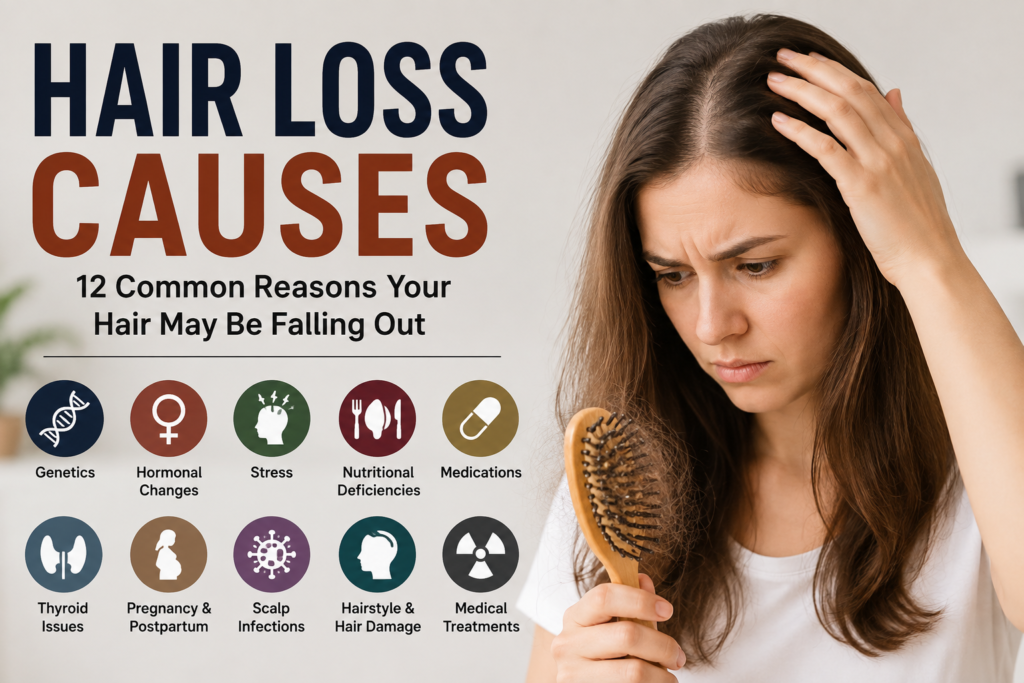
Noticing more hair than usual on your pillow, in your shower drain, or on your brush can be worrying. But understanding the hair loss causes behind that change is the first step toward finding the right solution. Hair can become thinner because of changes inside the body, problems affecting the scalp, inherited conditions, certain treatments, or repeated physical damage.
Hair loss does not always mean that something serious is wrong. Some forms are temporary and improve when the underlying problem is addressed. Others develop slowly and may need long-term treatment. The pattern, timing, and other symptoms can provide useful clues about what is happening.
This guide looks at several important hair loss causes in detail.
What Causes Hair Loss?
Hair loss happens when the normal balance between hair growth and shedding is disrupted. The reason for that disruption can vary from one person to another. Understanding hair loss and its possible causes can help you identify what may be affecting your hair growth and choose the right approach.
Some causes affect the hair follicle itself. Others make hairs enter the shedding stage earlier than expected. In some cases, the hair shaft becomes weak and breaks before it can reach its normal length.
Common causes include inherited hair loss, hormonal and medical conditions, infections, certain medicines, major physical stress, nutritional problems, and repeated pulling or damage to the hair.
Because several causes can look similar, the amount of hair you lose alone cannot tell you what is responsible.
1. Hereditary Hair Loss.
Genes are one of the most important hair loss causes. Hereditary hair loss is also called androgenetic alopecia and can affect both men and women.
This condition develops because hair follicles become increasingly sensitive to certain hormonal signals. Over time, affected follicles become smaller and produce finer, shorter hairs. Eventually, some follicles may stop producing visible hair.
The pattern is often different between men and women. Men may develop a receding hairline or thinning around the crown. Women more commonly develop reduced density over the top of the scalp or a wider part.
Because hereditary hair loss usually progresses gradually, people may not notice the change immediately.
Having a family history increases your risk, but the pattern is not always passed directly from one parent. Genes from both sides of the family can play a role.
2. Alopecia Areata.
Alopecia areata is an autoimmune condition and is a different type of hair loss from ordinary pattern baldness.
With alopecia areata, the immune system mistakenly attacks hair follicles. This can cause clearly defined, round or oval patches of hair loss. It may affect the scalp, eyebrows, eyelashes, beard, or other areas where hair grows.
The amount of hair loss can vary widely. Some people develop one small patch, while others lose much more hair.
The condition can also change over time. Hair may regrow without treatment in some people, while others experience repeated episodes.
If you suddenly develop smooth bald patches, it is worth getting a professional evaluation rather than assuming the problem is caused by shampoo, diet, or normal shedding.
3. Scalp Infections.
Your scalp is skin, so it can develop infections that affect hair growth.
One example is scalp ringworm, also known as tinea capitis. It is a fungal infection that can cause scaling, inflammation, broken hairs, and areas of hair loss. In some cases, the scalp may become swollen or develop drainage.
Unlike hereditary hair loss, an infection may come with noticeable changes in the scalp itself.
This distinction matters because treating the hair alone will not solve an active infection. Proper medical treatment can clear the infection and allow hair to grow again in many cases.
Children are particularly affected by scalp ringworm, although adults can develop it as well.
4. Thyroid Problems.
The thyroid gland helps regulate many body processes, and thyroid disorders can affect hair growth.
Both an underactive thyroid and an overactive thyroid can be associated with hair thinning or increased shedding. In some people, the change may be spread across the scalp rather than appearing as one specific bald area.
Hair changes may occur alongside other symptoms of thyroid disease, such as changes in energy, weight, body temperature tolerance, heart rate, or menstrual patterns.
The important point is that hair loss alone cannot diagnose a thyroid problem. If you have persistent shedding together with other symptoms, a healthcare professional can determine whether thyroid testing is appropriate. Treating an underlying thyroid disorder can help reverse related hair loss.
5. Rapid Weight Loss and Very Low-Calorie Diets.
A major change in body weight can affect the hair growth process.
When someone loses a significant amount of weight quickly, especially while eating too few calories, the body may not receive enough energy and nutrients to support normal hair production. This can trigger increased shedding.
The problem is not simply the number on the scale. Rapid dieting can also reduce intake of protein, iron, zinc, and other nutrients that the body needs.
This type of shedding may not appear immediately. Some people notice increased hair fall weeks or months after a major dietary change.
A balanced eating pattern is generally a better approach than extreme calorie restriction. If significant hair shedding follows rapid weight loss, identifying and correcting the underlying nutritional problem is more useful than simply buying a hair supplement.
A balanced eating pattern is generally a better approach than extreme calorie restriction. If significant hair shedding follows rapid weight loss, identifying and correcting the underlying nutritional problem is more useful than simply buying a hair supplement.
6. Iron Deficiency.
Iron deficiency is another possible cause of increased hair shedding.
Iron plays an important role in the body’s normal functions, and low iron levels can be associated with hair loss. This may be particularly relevant for people who have heavy menstrual bleeding, limited dietary iron intake, or certain medical conditions that affect iron levels.
However, hair loss does not automatically mean you have an iron deficiency.
Taking iron supplements without knowing whether you actually need them is not a good idea. Too much iron can cause problems, and the appropriate treatment depends on the underlying reason for the deficiency.
If a healthcare professional suspects iron deficiency, they may recommend blood tests before deciding whether supplementation is appropriate.
7. Protein and Other Nutritional Deficiencies.
Hair is made largely from keratin, a protein. The body therefore needs adequate nutrition to maintain normal hair production.
Not getting enough protein can contribute to hair problems. Deficiencies involving nutrients such as zinc or biotin can also be associated with noticeable hair loss.
This does not mean that taking large amounts of vitamins will automatically make hair grow faster.
Supplements are most useful when they address a genuine deficiency or a medically identified need. In people who already get enough nutrients, taking extra supplements may provide little benefit and, in some cases, excessive intake of certain nutrients can cause harm.
A varied diet that includes adequate protein and nutrient-rich foods is a sensible foundation for healthy hair.
8. Hair Loss After Pregnancy.
Pregnancy can bring major hormonal changes, and those changes can affect the hair cycle.
Some women notice fuller-looking hair during pregnancy. After delivery, a larger number of hairs may enter the shedding phase around the same period. This can make hair appear noticeably thinner.
The shedding often becomes noticeable several months after childbirth rather than immediately after delivery.
This pattern is usually temporary. As the hair cycle returns toward its usual pattern, the amount of shedding generally decreases and fullness can improve. The American Academy of Dermatology notes that many women regain their normal hair fullness within several months after this type of shedding.
Persistent or severe hair loss after pregnancy still deserves medical attention, especially when other symptoms are present.
9. Certain Medications.
Medication-related hair loss can be easy to miss because the medication may be taken for a completely different health problem.
Several types of medicines can cause hair loss as a side effect. Examples include some medicines used for cancer, arthritis, depression, heart conditions, gout, and high blood pressure.
The timing can also make the connection difficult to recognize. Hair shedding may not happen immediately after starting a medication.
If you suspect a medicine is contributing to hair loss, do not stop taking it on your own. Speak with the healthcare professional who prescribed it. They can review the medication, consider other possible causes, and decide whether a change is appropriate.
10. Radiation and Cancer Treatment.
Some cancer treatments can cause significant hair loss.
Chemotherapy can affect rapidly dividing cells, including cells involved in hair production. Depending on the treatment, hair may fall from the scalp and other parts of the body.
Radiation therapy can also cause hair loss when the treated area includes the scalp. The amount of regrowth depends on factors such as the radiation dose and treatment area.
This type of hair loss should be discussed with the oncology team. Hair usually becomes a lower priority when treating cancer, but understanding what to expect can make the treatment process easier to manage.
11. Tight Hairstyles and Repeated Pulling.
Hair can also be damaged by repeated tension. Regularly wearing hairstyles that pull tightly on the scalp, such as very tight braids, ponytails, or similar styles, can cause traction alopecia. At first, you may notice broken hairs, tenderness, or thinning around areas under the most tension.
If the pulling continues for a long time, the damage can become permanent because repeated tension can injure hair follicles.
The earlier you reduce the tension, the better. Changing hairstyles and avoiding painful or excessively tight styles can help reduce further damage.
This is different from ordinary hair shedding because the problem comes from repeated physical stress on the follicles.
12. Scalp Inflammation and Scarring Conditions.
Some forms of hair loss occur when inflammation damages the hair follicle.
Scarring alopecias are a group of conditions in which inflammation can destroy hair follicles and replace them with scar tissue. Once a follicle is destroyed, it cannot produce hair again.
These conditions are less common than hereditary hair loss, but they are important because early diagnosis may help prevent additional permanent loss.
Possible warning signs include scalp redness, scaling, burning, pain, tenderness, itching, or areas that look unusually smooth or shiny.
If hair loss occurs together with persistent scalp inflammation, getting evaluated by a dermatologist is especially important.
Other Hair Loss Causes Worth Knowing.
Not every cause fits neatly into the common categories above.
For example, some people develop hair loss because of repeated hair pulling, known medically as trichotillomania. Others may lose hair because of friction from repeated rubbing against the skin. Certain sexually transmitted infections can also cause hair loss, while rare toxic exposures can affect hair growth.
These causes are much less common, but they show why diagnosing hair loss based only on appearance can be difficult.
The same amount of hair shedding can have very different causes in different people.
How Can You Tell What Is Causing Your Hair Loss?
Looking at the pattern can provide clues, but it cannot always provide a diagnosis.
For example:
- Gradual thinning may point toward hereditary hair loss.
- Smooth, round bald patches can occur with alopecia areata.
- Scaling and broken hairs may suggest a scalp infection.
- Hair loss after a major physical event may be related to a disrupted hair cycle.
- Thinning around areas under constant tension may suggest traction alopecia.
- Hair loss with other body-wide symptoms may point toward a medical or nutritional issue.
A healthcare professional may examine the scalp and hair closely and ask about your medical history, diet, medications, recent illnesses, weight changes, and family history. Blood tests or other tests may be appropriate in some cases.
The goal is not simply to stop hair from falling. It is to identify why the loss is happening.
When Should You Get Medical Advice?
Consider seeing a healthcare professional if your hair loss is sudden, severe, persistent, or noticeably different from your usual shedding.
You should also seek medical advice if you develop:
- Sudden bald patches
- Significant scalp pain or inflammation
- Scaling, redness, or swelling
- Rapid thinning
- Hair loss affecting the eyebrows or other body areas
- Hair loss together with unexplained health changes
- Persistent shedding that concerns you
Sudden or patchy hair loss can sometimes signal an underlying medical condition, so it is better to investigate the cause rather than rely on trial and error.
Final Thoughts.
There is no single explanation for hair loss. Genetics, autoimmune conditions, scalp infections, thyroid disorders, rapid weight loss, nutritional deficiencies, medications, pregnancy-related changes, cancer treatments, repeated tension, and inflammatory scalp conditions can all play a role.
That is why finding the right hair loss causes matters before choosing a treatment.
If your hair is thinning gradually, you may be dealing with a common inherited pattern. If the change happens suddenly, appears in patches, or comes with scalp symptoms, a different cause may be involved.
The best approach is to look at the timing, pattern, other symptoms, and possible triggers together. When the cause is unclear or the hair loss is significant, professional evaluation can help you avoid ineffective treatments and identify the most appropriate next step.


Related Blogs
Hair Loss: Causes, Treatments, and Proven Ways to Support Healthy Hair Growth.
Hair loss is one of the most common concerns for both men and women. While losing a small amount of...
Baby Health Guide to Help Your Baby Growth.
Our Blogs Details Baby Health Guide to Help Your Baby Growth. Author Top Health Solutions. Post Date April 24, 2026...
How to Treat Baby Fever at Home: Safe and Gentle Care Every Parent Should Know.
How to Treat Baby Fever at Home: Safe and Gentle Care Every Parent Should Know. Our Blogs Details How to...
